
Smarter Value Chains Through AI-Powered Resilience Planning
Editor's Note: This article was originally published by CORE Innovation Group on 22 May 2026 and is republished here with permission. Read the original article here.
Modern value chains are under pressure. Disruptions, competing priorities, and fragmented planning tools make it harder than ever for manufacturers to stay efficient, resilient, and competitive at once. Decisions about sourcing, production, warehousing, and delivery are still often made in silos, with limited visibility into how each choice ripples across the rest of the chain. The result: higher costs, slower responses, and organisations that are always reacting instead of planning ahead.
ResiChain was built to address exactly that.
From Fragmented Decisions to End-to-End Value Chain Intelligence
In complex manufacturing and logistics environments, planning decisions are rarely isolated. Sourcing delays affect production schedules, production bottlenecks impact warehousing needs, and warehouse constraints can disrupt delivery performance. Yet in many organisations, these decisions are still managed step by step, often within separate operational silos.
This fragmented approach can lead to higher costs, reduced responsiveness, missed sustainability targets, and increased vulnerability to disruptions. Optimising one part of the value chain in isolation may improve local performance, but it can also create unintended inefficiencies elsewhere.
ResiChain, developed by CORE Innovation Centre within the M4ESTRO framework, addresses this challenge by enabling manufacturers to plan across the entire value chain and over the full planning horizon. Rather than treating sourcing, production, warehousing, and delivery as disconnected activities, the platform evaluates their interdependencies and proposes coordinated strategies that support resilience, efficiency, and long-term competitiveness.
By transforming planning into a holistic, AI-driven process, ResiChain helps organisations move from reactive decision-making to proactive, informed value chain orchestration.
How ResiChain Works
ResiChain combines advanced optimisation capabilities with AI-driven decision intelligence to support end-to-end planning in dynamic industrial environments.
Data Integration and System Visibility
The platform collects and structures relevant operational inputs across the value chain, including sourcing constraints, production capacities, warehousing conditions, delivery requirements, and planning objectives. This provides a unified view of the planning environment and its operational dependencies.
End-to-End Planning Across the Horizon
Instead of evaluating decisions one stage at a time, ResiChain plans across the entire time horizon. It examines how each decision affects subsequent stages of the chain, allowing planners to anticipate downstream impacts before they materialise.
AI-Driven Optimisation
Powered by a Multi-Agent Reinforcement Learning engine, ResiChain generates optimised planning strategies that balance multiple objectives simultaneously, including cost, timing, sustainability, and resilience. The platform is designed to support decision-making in environments where trade-offs are unavoidable and conditions may change rapidly.
Alternative Scenarios and Trade-Off Analysis
A key strength of ResiChain is its ability to provide alternative planning strategies rather than a single static recommendation. This enables planners to compare options, understand trade-offs clearly, and choose the strategy that best aligns with business priorities and operational realities.
Decision Support Through Integrated Analysis
In combination with the Scoreboard Analyser and the Optimisation Engine, ResiChain helps decision-makers assess performance, compare scenarios, and identify the most robust course of action. The result is a more transparent and explainable planning process for both technical and business stakeholders.
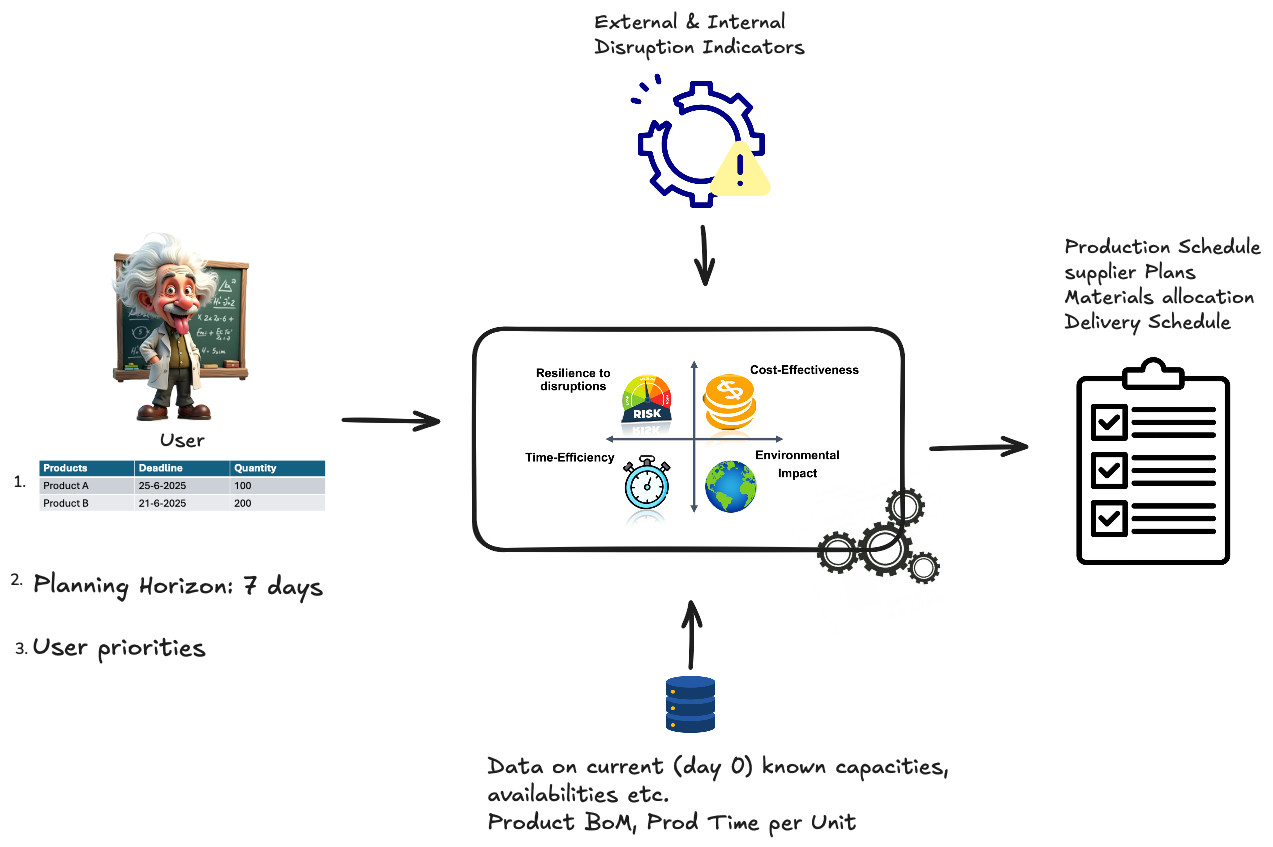
Conceptual workflow of the ResiChain AI optimisation process, showing how user-defined demand inputs, planning horizon, user preferences, disruption indicators, and current operational data are transformed into optimised production, supplier, material allocation, and delivery plans.
Coordinated Planning for Real-World Industrial Complexity
Modern value chains involve multiple actors, competing priorities, and constant uncertainty. ResiChain is designed to operate in this complexity by aligning planning decisions across the network around shared goals.
Its planning logic considers not only operational efficiency, but also broader strategic criteria such as:
resilience to disruption
coordination across actors
sustainability objectives
service and delivery performance
cost-aware resource allocation
This multi-dimensional approach allows ResiChain to support real-world industrial planning, where the best decision is rarely the cheapest or fastest in isolation. Instead, value emerges from balancing performance across the entire chain.
By supporting coordinated, system-level planning, ResiChain helps organisations reduce risk, improve adaptability, and strengthen value chain resilience in uncertain operating conditions.
Demonstrating the M4ESTRO Vision in Practice
The M4ESTRO demo showcases ResiChain in combination with the Scoreboard Analyser and the Optimisation Engine, illustrating how these components work together as an integrated solution for intelligent industrial planning.
Within this setup:
the Optimisation Engine generates planning logic and candidate strategies,
the Scoreboard Analyser evaluates outcomes and makes performance trade-offs visible,
and ResiChain brings these capabilities together into an AI-driven platform for coordinated end-to-end value chain planning.
This integrated demonstration highlights how M4ESTRO moves beyond isolated digital tools toward a connected planning ecosystem, where advanced analytics, optimisation, and AI collaborate to support better industrial decisions.
The result is a practical demonstration of how manufacturers can strengthen competitiveness while operating more efficiently, sustainably, and confidently in unpredictable environments.