
A Federated Learning Framework for Secure Collaboration among Supply Chain Actors
Over the past few months, our team of experts at M4ESTRO has been working on the development of AI solutions for distributed manufacturing networks that allow privacy and secure collaboration among network members. This work, led by our colleagues at Netcompany and carried out in collaboration with the other M4ESTRO partners, fuels a clear goal: to deliver solutions that allow different supply chain actors to work together while still keeping their sensitive operational data secure and local to each actor. This is where decentralised, federated learning approaches and collaborative intelligence come into play.
How it works
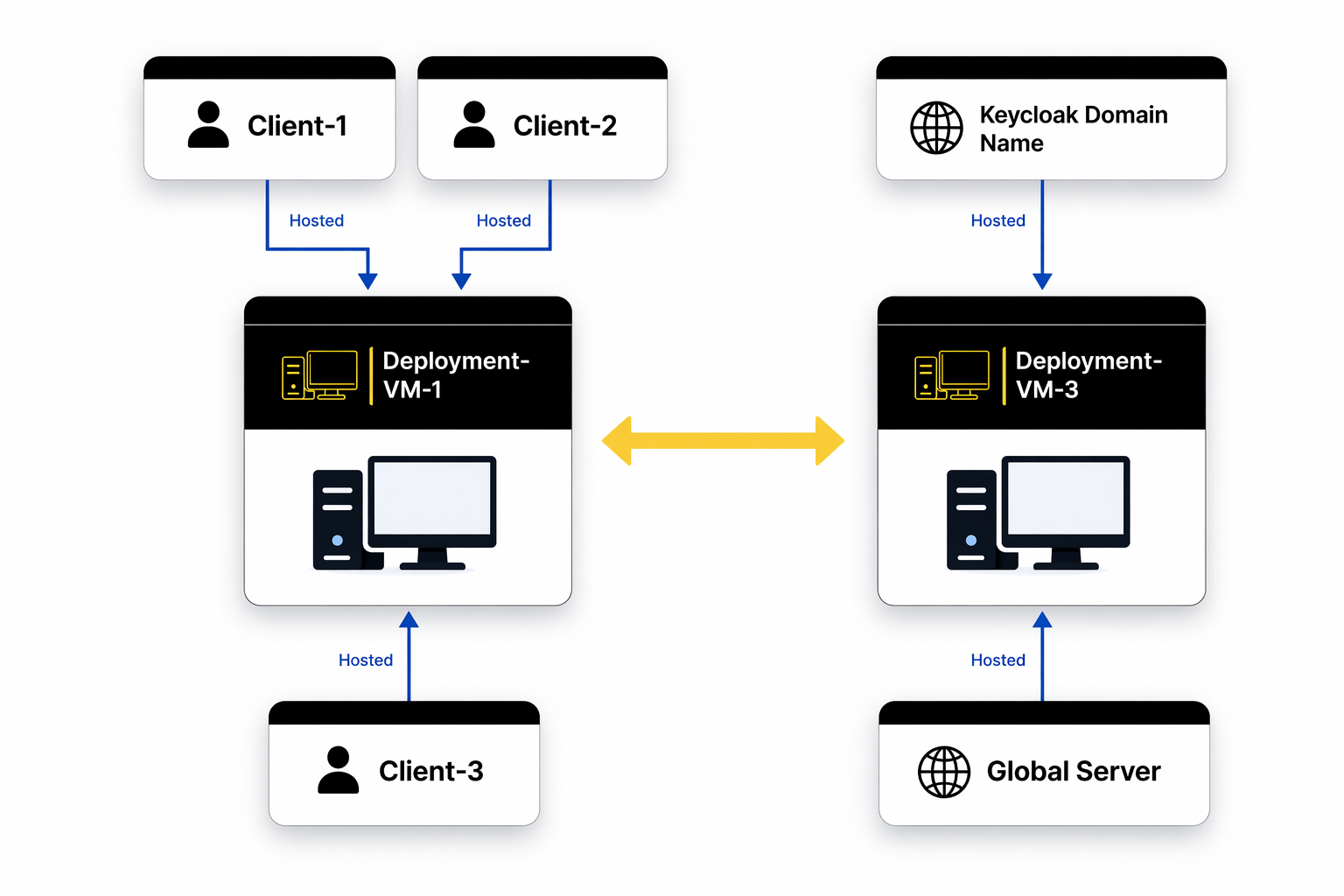
Netcompany designed and deployed a dedicated federated learning simulation environment to validate the end-to-end workflow in a realistic yet controlled setting. The current infrastructure consists of two deployment virtual machines: one hosts two federated learning clients while the other acts as the global aggregation node. The global server is hosted in a secure environment with identity and access management services, while the clients run independently in a separate deployment environment. Data Space connectors have been integrated to enable policy-based, contract-driven model exchange among participants to achieve secure and trusted communication across nodes.
Within this testing network, each client trains a local machine learning model using its own local dataset. Once the training is completed, model updates are published to the Data Space under predefined usage contracts. The global node periodically polls the Data Space, retrieves available local models, performs aggregation, and publishes the updated global model back to the participating clients. The clients then retrieve the global model before initiating the next training round. This closed-loop orchestration validates the federated learning lifecycle, including local training, contractual exchange, server-side aggregation, redistribution of the global model, and synchronization across nodes.
To verify the robustness of the communication and aggregation mechanisms, a placeholder MNIST model is currently used as a demonstrator. This controlled setup allows the team to finalize and stress-test the exchange of federated learning insights within the dedicated testing infrastructure, ensuring that data space integration, contract negotiation, and model synchronization operate reliably before transitioning to a production-oriented model.
What lies ahead
The next phase of this work will focus on introducing a domain-specific machine learning model aligned with the core objectives of M4ESTRO. This new model will move beyond the placeholder demonstrator and target supply chain resilience use cases, including the detection of disruptions, anomalies, and performance deviations across distributed manufacturing environments. By embedding resilience-oriented intelligence within the federated framework, the solution will enable participating actors to collaboratively build predictive and adaptive capabilities without exposing sensitive operational data.
Through this progression from prototype validation to resilience-focused intelligence, this work is laying the technical and architectural foundations for a decentralised AI ecosystem that supports transparent, flexible, and resilient manufacturing value networks in line with M4ESTRO’s strategic vision.