
TRIMEK Use-Case: Integrating Advanced In-Line Metrology into CNC Machining
At M4ESTRO, the TRIMEK use case focuses on the validation of manufacturing services for components used in the aerospace and automotive sectors. It will demonstrate a “Metrology as a Service" (METaaS) solution that can integrate manufacturing services into a Coordinate-Measuring Machine (CMM). The CMM will be able to self-manufacture crucial parts via additive manufacturing and contribute to the production of tools for complex part quality control.
Taking stock of what has been achieved thus far, we see the TRIMEK use case has successfully marked a key milestone: the integration of an Optiscan sensor in the CNC machine of our colleagues at Mondragon University (MGEP) for advanced metrology.
The integration process has been completed end-to-end, including:
Sensor installation
Connectivity and functionality verification
Calibration and validation testing
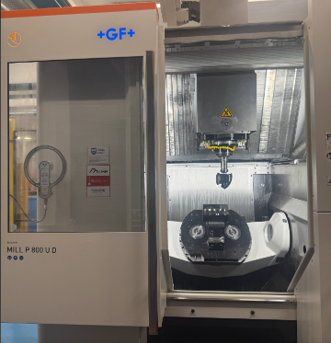
Photo credit: Mondragon Unibertsitatea
In parallel, MGEP personnel have been trained on the use of the in-line metrology solution to ensure that the system can be operated confidently and independently.
This integrated setup makes it possible to carry out dimensional inspections directly during the manufacturing process, without removing the part from the machine and transferring it to a metrology laboratory. By embedding metrology into the production workflow, quality assurance becomes an integral part of manufacturing rather than a separate, downstream activity.
Looking ahead, one of TRIMEK’s Coordinate Measuring Machines (CMMs) will be upgraded to incorporate additive manufacturing capabilities directly within the measurement system.
This upgrade will enable collaborative hybrid manufacturing supported by advanced metrology, allowing the system to:
Produce high-precision CMM components
Increase CNC machine operational resilience
Reduce reliance on external suppliers for fixture components
Together, these developments demonstrate how advanced metrology, when tightly integrated with manufacturing systems, can support more robust, flexible, and autonomous manufacturing environments.